Frozen in Time: Voids as Pristine Laboratories of Physics
Why cosmic voids matter: pristine evolution
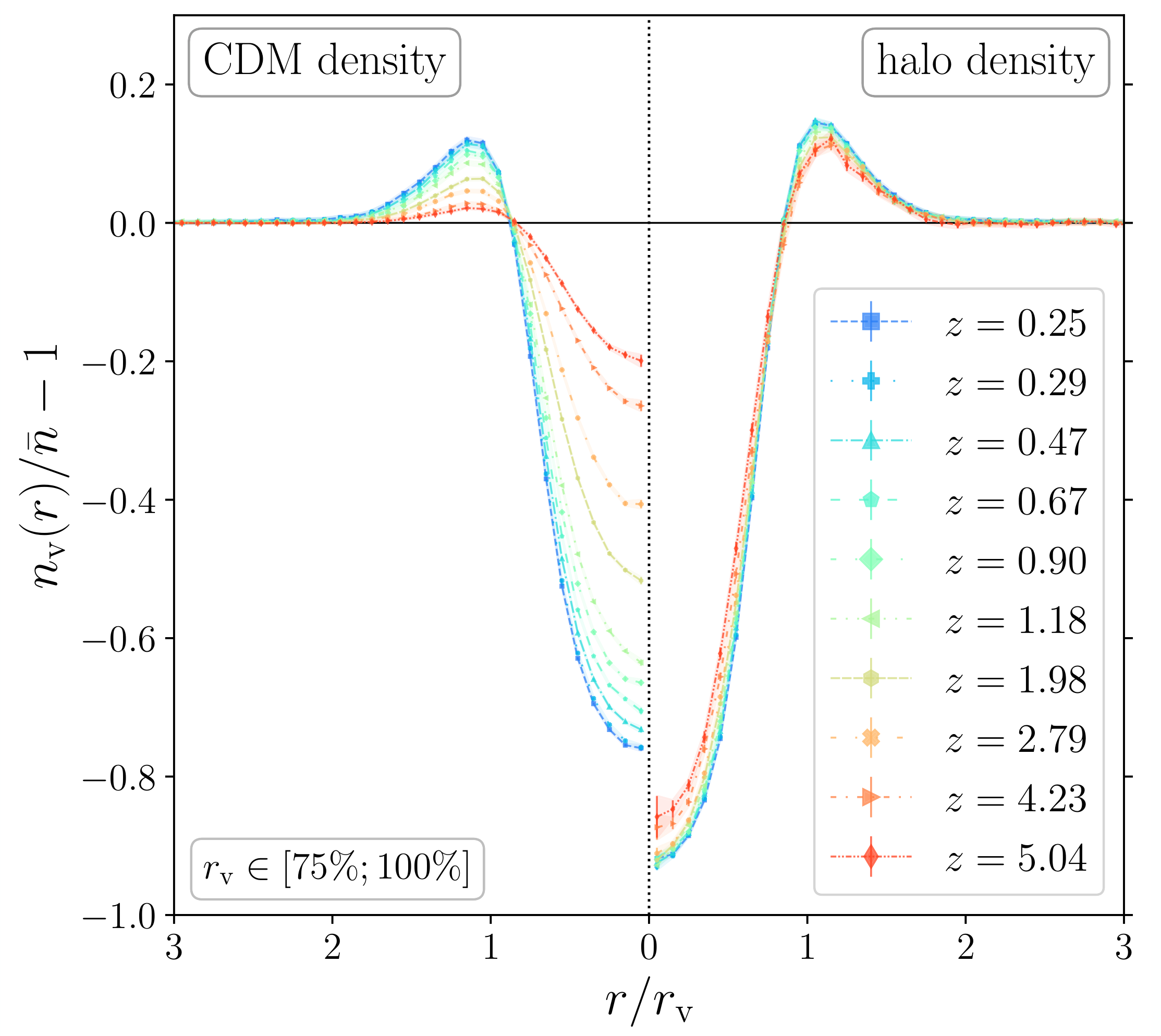
The history of the universe is a tug-of-war between the attractive force of gravity and the repulsive push of dark energy. While galaxies and clusters are defined by chaotic mergers and rapid gravitational growth, cosmic voids are the emptiest regions of space and the first places where gravity loses this battle. This makes them a unique window into exactly how and when cosmic expansion takes over.
To uncover this transition, we utilized state-of-the-art cosmological simulations to trace the life cycle and evolution of these underdense regions across 12.5 billion years of history. By categorizing voids based on their relative rank within their population rather than their absolute physical size, we successfully mitigated the selection biases introduced by galaxy formation that otherwise can lead to counterintuitive results. Through this relative framework, we discovered that void evolution is not a continuous process of emptying out. Instead, once the universe reaches a certain age, these structures settle into a calm and stable state, passively following the expansion of the cosmos.
This stabilization is clearly visible in the image above. While the dark matter densities on the left side show an expected evolution, with densities inside voids decreasing as matter evacuates and accumulates at their boundary, the densities of halos (our proxies for visible galaxies) on the right remain remarkably stable over time. Moreover, we also discovered that the expected evolution of dark matter densities can be reliably predicted with simple linear growth theory. Small deviations still persist, but these may point toward interpreting voids as ‘separate universes’ that exhibit a naturally earlier and more potent dark energy onset.
Ultimately, these stable voids offer an exquisite and reliable window into the nature of dark energy, paving the way for more accurate measurements of the accelerated expansion of the cosmos.
Official abstract
Published version: JCAP (2026) →