Kai Lehman, Nico Schuster, Luisa Lucie-Smith, Nico Hamaus, Christopher T. Davies & Klaus Dolag
Cosmic voids are among the most powerful tools we have for mapping the universe, but they come with a high computational cost. To accurately predict their sizes and densities, researchers traditionally have to run massive, time-consuming simulations for every single variation of the universe’s physical parameters and laws.
To solve this, we developed a set of “emulators” based on neural networks. By training these algorithms on thousands of gravity-only simulations, we created an AI capable of predicting void statistics almost instantly by learning how these statistics depend on the physical parameters of the universe. This allows us to bypass the need for brute-force computation, enabling much faster and more reliable cosmological parameter estimation.
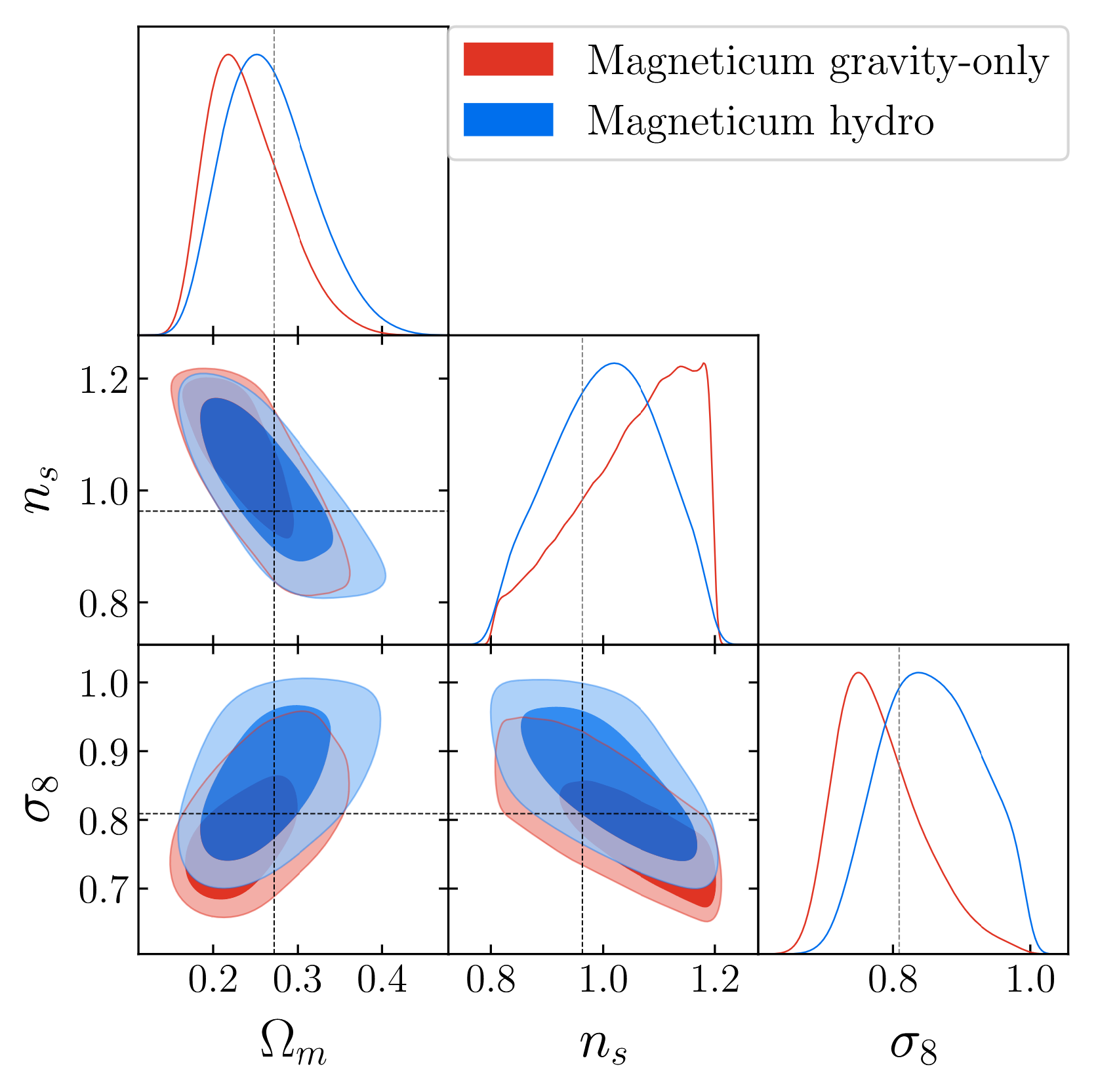
The image above highlights the impressive reliability of these emulators, maintaining high performance across diverse data sets. We proved that these emulators remain accurate even when applied to simulations with different resolutions or the added complexity of “messy” gas and star formation physics. Ultimately, this approach turns cosmic voids into a robust probe, allowing us to measure the universe’s fundamental ingredients with great efficiency.
These findings demonstrate that neural network emulators can successfully maintain accuracy despite the absence of “messy” gas and star formation physics in the training process, highlighting that voids are a highly reliable probe for extracting cosmological information.
Official abstract
Context. Cosmic voids are a promising probe of cosmology for spectroscopic galaxy surveys due to their unique response to cosmological parameters. Their combination with other probes promises to break parameter degeneracies. Aims. Due to simplifying assumptions, analytical models for void statistics represent only a subset of the full void population. We present a set of neural-based emulators for void summary statistics of watershed voids, which retain more information about the full void population than simplified analytical models. Methods. We built emulators for the void size function and void density profiles traced by the halo number density using the Quijote suite of simulations that spans a wide range of the Λ cold dark matter (ΛCDM) parameter space. The emulators replace the computation of these statistics from computationally expensive cosmological simulations. We demonstrate the cosmological constraining power of voids using our emulators, which offer orders-of-magnitude acceleration in parameter estimation, capture more cosmological information compared to analytical models, and produce more realistic posteriors compared to Fisher forecasts. Results. In this Quijote setup, we recover the parameters \( \Omega_\mathrm{m} \) and \( \sigma_8 \) to within 14.4% and 8.4% accuracy, respectively, using void density profiles. Incorporating additional information from the void size function improves the accuracy for \( \sigma_8 \) to 6.8%. We demonstrate the robustness of our approach with respect to two important variables in the underlying simulations: the resolution and the inclusion of baryons. We find that our pipeline is robust to variations in resolution, and we show that the posteriors derived from the emulated void statistics are unaffected by the inclusion of baryons in the Magneticum hydrodynamic simulations. This opens up the possibility of a baryon-independent probe of the large-scale structure.