Nico Schuster, Nico Hamaus, Alice Pisani, Carmelita Carbone, Christina D. Kreisch, Giorgia Pollina & Jochen Weller
Neutrinos are the lightest massive particles that we know of, but their exact mass is still one of the biggest unknowns in particle physics. Unlike regular matter, neutrinos move too fast to be trapped by the gravitational pull of typical galaxies and their dark matter halos, meaning they naturally flow into the nearly empty regions of space, cosmic voids, potentially altering them in the process.
Through dedicated simulations, we investigated how these lightweight particles affect the properties of voids. By analyzing the clustering bias of these voids, a measure of how voids are distributed relative to the overall matter in the universe, we found that void properties are highly sensitive to the total sum of neutrino masses.
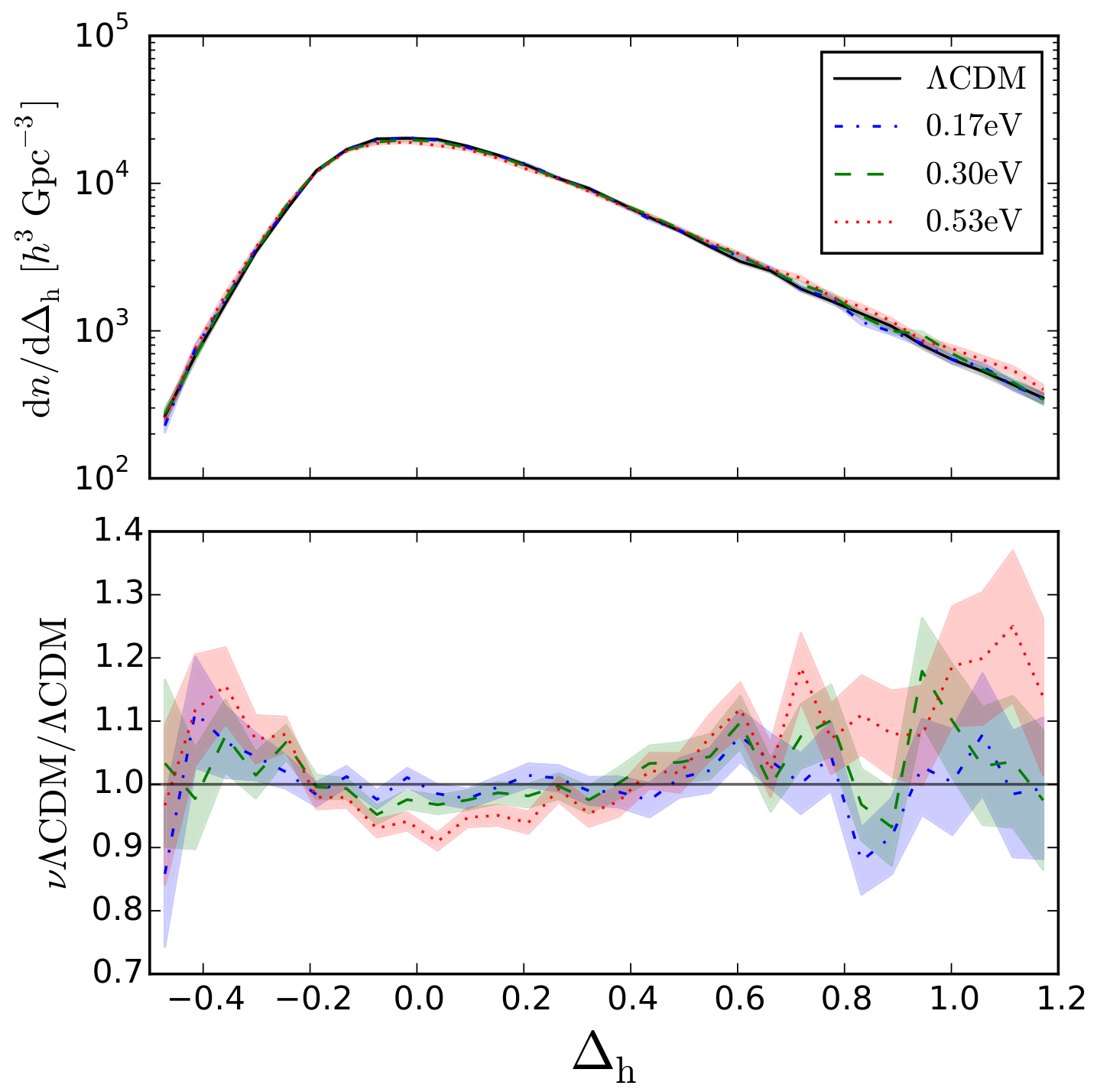
Our research shows that by categorizing voids based on their minimal density and average density ( \( \Delta_\mathrm{h}\) in the image above), we can isolate distinct neutrino signatures. For example, in cosmologies with massive neutrinos, we find more voids at smaller and larger average densities, while voids with densities around the mean ( \( \Delta_\mathrm{h}=0 \) ) become rarer.
These unique signatures highlight that the largest empty spaces in the universe can be used as a precision scale to weigh its lightest known particles.
Official abstract
Cosmic voids offer an extraordinary opportunity to study the effects of massive neutrinos on cosmological scales. Because they are freely streaming, neutrinos can penetrate the interior of voids more easily than cold dark matter or baryons, which makes their relative contribution to the mass budget in voids much higher than elsewhere in the Universe. In simulations it has recently been shown how various characteristics of voids in the matter distribution are affected by neutrinos, such as their abundance, density profiles, dynamics, and clustering properties. However, the tracers used to identify voids in observations (e.g., galaxies or halos) are affected by neutrinos as well, and isolating the unique neutrino signatures inherent to voids becomes more difficult. In this paper we make use of the DEMNUni suite of simulations to investigate the clustering bias of voids in Fourier space as a function of their core density and compensation. We find a clear dependence on the sum of neutrino masses that remains significant even for void statistics extracted from halos. In particular, we observe that the amplitude of the linear void bias increases with neutrino mass for voids defined in dark matter, whereas this trend gets reversed and slightly attenuated when measuring the relative void-halo bias using voids identified in the halo distribution. Finally, we argue how the original behaviour can be restored when considering observations of the total matter distribution (e.g. via weak lensing), and comment on scale-dependent effects in the void bias that may provide additional information on neutrinos in the future.