Do messy baryons spoil cosmic voids?
Why cosmic voids matter: mitigation of baryonic physics
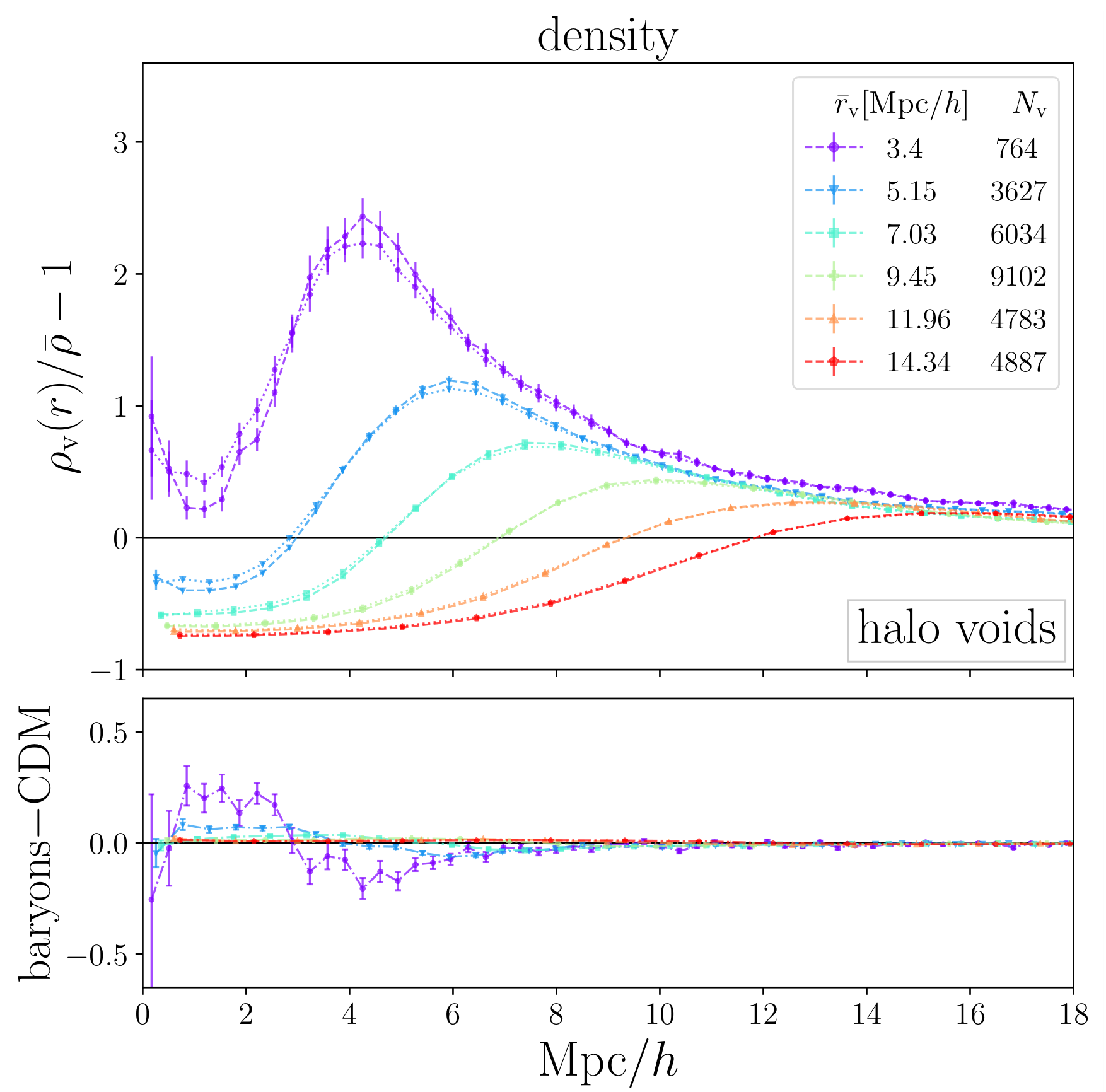
The visible universe is shaped by violent astrophysical processes, from star formation to supermassive black holes driving gas out of galaxies. However, when physicists model the universe on a computer, they often simulate only dark matter and its gravity, as these other baryonic processes are incredibly complex and computationally expensive. While this shortcut leads to inaccuracies when predicting the properties of densely packed galaxies, we wanted to know if and how much these messy baryonic effects also disrupt the quiet, vast expanses of cosmic voids.
To find out, we utilized state-of-the-art hydrodynamical simulations to track both normal matter and dark matter, comparing them directly to standard dark-matter-only (gravity-only) simulations. The results were incredibly reassuring: cosmic voids are fundamentally robust, and their overall properties are virtually untouched by the complex physics of normal matter.
However, looking closely at the mass around these voids reveals a subtle but clear difference, as seen in the image above. Because normal matter (dotted lines) interacts not only through gravity but also experiences pressure and explosive feedback, it gets smoothed out and pushed into the interiors of voids, leading to slightly higher inner densities. Meanwhile, cold dark matter (dashed lines), interacting solely through gravity, clumps much more sharply at the void boundaries.
By demonstrating that messy astrophysics barely alters voids, we establish that we can safely rely on straightforward, gravity-only simulations to generate robust statistics for comparison against measurements from next-generation cosmological surveys. Furthermore, the higher densities of gas found inside these voids might provide a crucial key to ultimately locating the missing baryons in our universe.
Official abstract
Published version: JCAP (2024) →