Simple dynamics inside the emptiest places
Why cosmic voids matter: nonlinear structure & linear dynamics
While denser regions of the cosmic web, like massive galaxy clusters, are dominated by complex gravitational forces, gravity behaves more gently in the emptiest regions of space, offering cleaner physical environments. Cosmic voids are actively expanding, pushing matter outward in a highly organized way that avoids the messy physics found elsewhere in the universe.
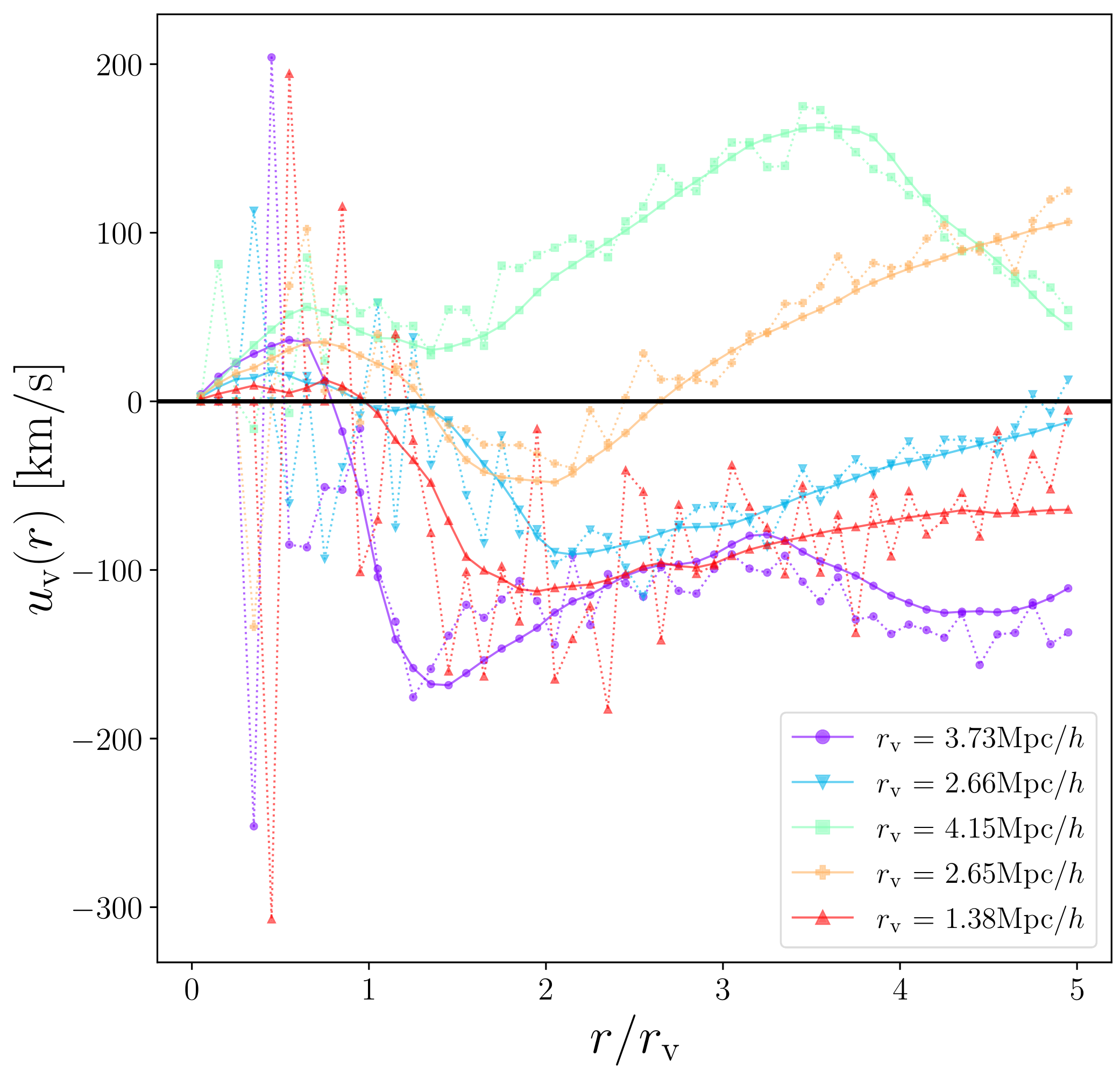
Using state-of-the-art hydrodynamical simulations (which include additional physics alongside standard gravity) across a vast range of scales, we investigated exactly how matter and galaxies move around these underdense regions. Surprisingly, we discovered that these motions can be described exquisitely well by the simple equations of linear mass conservation.
As shown in the image above, this holds true even for incredibly small, individual voids on scales of just a few megaparsecs, a regime where we would normally expect the physics to become highly nonlinear. Yet, the measured velocities of galaxies (dotted lines) match the simple theoretical predictions (solid lines) very well.
This confirms that despite the complexity of the surrounding cosmic web, voids provide a uniquely clean and mathematically predictable laboratory for precision cosmology.
Official abstract
Published version: JCAP (2023) →